
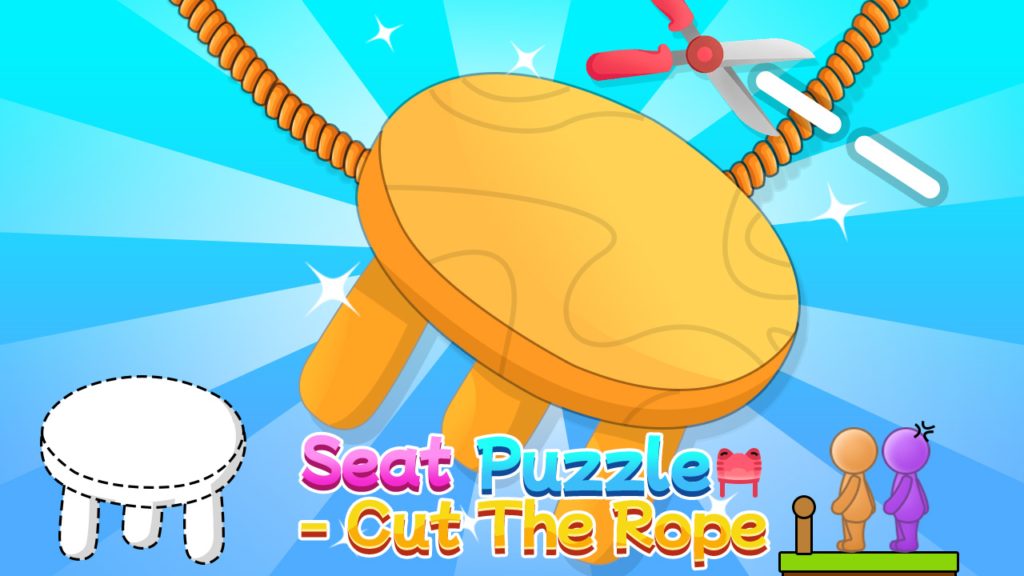
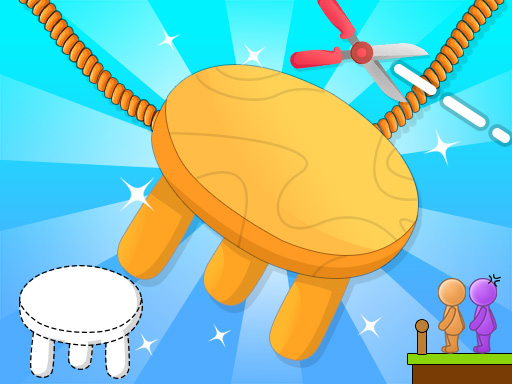
Face a wildly satisfying brain challenge in Seat Puzzle – Cut The Rope. This addictive puzzle game blends smart logic with relaxing casual gameplay, creating the perfect experience for those who love thinking fast and solving clever challenges. In each level, chairs are bound by ropes. Your task is to cut the ropes according to the passengers’ colors.
Welcome to a puzzle experience that is both simple to understand and surprisingly deep to master. Developed by PuzzleGame.Com, Seat Puzzle Cut The Rope takes a familiar concept—cutting ropes to free objects—and adds a brilliant twist: color-coded passengers who must be matched with chairs of the same color, all while navigating a web of interconnected ropes.
This comprehensive guide covers everything you need to know about Seat Puzzle Cut The Rope: gameplay mechanics, level progression, strategies for solving even the most complex puzzles, and why this game has become a favorite among fans of logic puzzles and brain teasers.
What Is Seat Puzzle Cut The Rope? An Overview
Seat Puzzle Cut The Rope is a logic puzzle game that combines physics-based rope cutting with color-matching mechanics. Each level presents a scene where chairs are tied up with ropes. Passengers of different colors need to sit in chairs. But here is the catch—the ropes are connected in complex webs, and cutting one rope may affect multiple chairs.
Your objective is simple: cut the ropes according to the passengers’ colors. But achieving that objective requires careful observation, logical deduction, and strategic planning.
The game is wildly satisfying because each solved puzzle feels earned. You are not guessing. You are thinking. And when the ropes fall exactly as you intended, and every passenger lands in the correct colored chair, the satisfaction is immense.
Why Seat Puzzle Cut The Rope stands out:
- Unique mechanic – Combines rope cutting with color matching
- Increasing difficulty – Gentle learning curve that becomes genuinely challenging
- Relaxing pace – No timers, no pressure, think at your own speed
- Satisfying physics – Ropes react realistically when cut
- Clean visuals – Chairs and passengers are clearly distinguished by color
- Play anywhere – Browser-based with no download required
Core Gameplay Mechanics
The Basic Setup
Each level consists of:
- Chairs – Positioned around the screen, each with a specific color (red, blue, green, yellow, etc.)
- Passengers – Small characters sitting in or floating above chairs, also with specific colors
- Ropes – Connecting chairs to each other, or chairs to anchor points
- Cut points – Locations where you can click/tap to cut a rope
The initial state shows passengers and chairs mixed up. Passengers may be in chairs of the wrong color, or floating untethered. Ropes bind the arrangement together.
The Goal
Your goal is to cut ropes so that each passenger ends up in a chair that matches their color. A red passenger must sit in a red chair. A blue passenger in a blue chair. And so on.
When you cut a rope, chairs and passengers affected by that rope may move, fall, swing, or rotate. The physics are realistic—cut ropes release tension, allowing connected objects to respond to gravity.
Color Matching Rules
- Passengers and chairs have distinct, clearly visible colors
- Some levels have multiple passengers of the same color
- Some levels have extra chairs (more chairs than passengers)
- The solution is not always obvious—sometimes you must cut ropes in a specific sequence
The Cutting Mechanic
To cut a rope:
- Click or tap on the rope you want to cut
- The rope snaps, and physics take over
- Affected chairs and passengers move according to gravity and remaining connections
You can cut ropes one at a time. There is no limit on the number of cuts per level (though some levels may have a “par” or suggested minimum).
Physics and Gravity
The game simulates basic physics:
- Gravity pulls downward – Chairs and passengers fall if unsupported
- Ropes are taut – They hold connected objects in place
- Cutting releases tension – Objects swing or fall depending on remaining supports
Understanding how physics will affect your cuts is essential. Cutting the wrong rope could send a passenger falling off the screen entirely—failing the level.
Level Completion
A level is complete when:
- Every passenger is seated in a chair (not floating or falling)
- Every passenger’s color matches their chair’s color
- No passenger is in mid-air or off-screen
When you achieve this, the game displays a success message and unlocks the next level.
Failure Conditions
You can fail a level if:
- A passenger falls off the screen (out of bounds)
- A passenger lands in a chair of the wrong color
- A passenger remains floating (not seated) after all cuts
Some levels allow retry from the beginning. Others may allow you to reset individual cuts (undo). Check your version.
Level Progression and Difficulty Curve
Seat Puzzle Cut The Rope features a well-designed difficulty curve that introduces new mechanics gradually.
Early Levels (Tutorial)
The first 5-10 levels teach you the basics:
- Single rope, single passenger
- One chair, one passenger, obvious cut
- Introduction to color matching (red passenger → red chair)
These levels are almost impossible to fail. They build confidence.
Intermediate Levels (Mechanics Introduction)
Levels 11-30 introduce complexity:
- Multiple passengers and chairs
- Ropes connecting multiple chairs in chains
- Passengers starting in wrong-colored chairs
- Gravity effects (chairs stacked, ropes holding them up)
You will need to plan cut sequences now. Cutting in the wrong order may trap a passenger.
Advanced Levels (Complex Puzzles)
Levels 31-50 require serious thought:
- Interconnected rope webs (cutting one rope affects many)
- Passengers suspended above chairs (timing matters)
- Obstacles that block movement
- Multiple solutions (but only one correct sequence)
- “Trick” puzzles where obvious first cuts are wrong
These levels may require restarting multiple times to find the solution.
Expert Levels (Brain Melters)
Levels 50+ are genuinely difficult:
- 10+ passengers and chairs
- Ropes forming complex geometric patterns
- Color duplicates (multiple red passengers, multiple red chairs)
- Moving platforms or rotating elements
- Tight margins (one wrong cut fails the level)
Expert levels reward careful analysis. Do not guess—deduce.
Master Levels (Bonus Content)
After completing the main campaign, Master Levels offer extreme challenges:
- Limited cuts (you must solve in X cuts)
- Timed challenges (for players who want speed)
- “No hints” mode (tutorial text removed)
- Level editor (create and share your own puzzles)
Master Levels are optional but provide hundreds of additional hours of content.
Strategies for Success
Beginner Strategies
1. Identify all passengers and their colors first. Before cutting anything, look at the level. Count the passengers. Note their colors. Find chairs of matching colors. Understand what the goal state looks like.
2. Look for obvious mismatches. If a passenger is in a chair of a different color, that chair is probably not their final destination. You will need to move them.
3. Cut supporting ropes from the bottom up. Ropes that hold up lower chairs often affect higher chairs. Cutting a lower support may cause a cascade. Cut from the bottom to maintain control.
4. Use gravity to your advantage. Cutting a rope makes things fall. If you need a passenger to move downward to reach their chair, cut the rope holding them up.
5. Do not cut all ropes at once. Cut one rope. Observe what happens. See if passengers move toward correct chairs. Then cut another. Rushing leads to failure.
6. Restart if you get stuck. There is no penalty for restarting a level. Sometimes starting fresh with a new perspective is faster than trying to fix a tangled mess.
Intermediate Strategies
1. Work backward from the goal. Imagine the final state: every passenger in the correct colored chair. Now think: what cuts must happen to achieve that? Working backward is often easier than working forward.
2. Identify “keystone” ropes. Some ropes, when cut, free multiple passengers at once. These are high-value cuts. However, cutting them too early may cause chaos. Identify them, but cut them at the right moment.
3. Create a cut sequence mentally. Before making any cut, visualize the entire sequence. “I will cut rope A, then rope B, then rope C.” If you cannot visualize the outcome, you are not ready to cut.
4. Watch for symmetry. Many levels are symmetrical. If the left side mirrors the right side, the solution probably also mirrors. Solve one side, then apply the same cuts to the other side.
5. Use the reset button freely. If a cut leads to an undesirable outcome, reset the level and try a different approach. Learning from mistakes is the core of puzzle games.
6. Learn common patterns. Over time, you will recognize recurring rope configurations. A “V” shape usually means two chairs are holding up a third. A “triangle” means stability—cut one side and the structure may collapse.
Advanced Strategies
1. Analyze degrees of freedom. Each chair has a certain number of ropes attached. Cutting one rope reduces the degrees of freedom. A chair with two ropes attached can swing but not fall. A chair with one rope attached can swing in an arc. A chair with no ropes falls straight down.
2. Use physics to predict movement. When you cut a rope, objects do not just fall straight down. They swing like pendulums. A passenger swinging to the left might land in a different chair than one falling straight down.
3. Plan for bounces. If a falling passenger hits another chair on the way down, they may bounce or deflect. This can be useful or disastrous. Account for it.
4. Consider multiple solutions. Some levels have more than one correct sequence. The “best” solution uses the fewest cuts or the most elegant sequence. Speedrunners look for minimal-cut solutions.
5. Use “negative space” analysis. Instead of looking at what is connected, look at what is not connected. Passengers that are already in correct-colored chairs may not need to move. Identify them early and cut around them.
Expert Strategies
1. Memorize level solutions. In high-level play (Master Levels), memorizing the optimal cut sequence for each level allows you to solve them in seconds. This is how speedrunners achieve record times.
2. Create your own levels. Some versions include a level editor. Designing puzzles for others is an excellent way to understand the game’s logic deeply. You will discover new mechanics.
3. Analyze rope tension. Ropes are not all equal. Some ropes are taut (under tension). Others are slack. Cutting a taut rope causes immediate movement. Cutting a slack rope does nothing (initially). Check which ropes are taut before cutting.
4. Use “test cuts.” Make a cut, observe what happens, then reset the level. This is a legitimate learning technique. There is no penalty for resetting.
5. Watch speedrun videos. For the most difficult levels, watching how expert players solve them can teach you techniques you would never discover on your own.
Common Mistakes and How to Avoid Them
Mistake 1: Cutting without a plan
The most common mistake. Players see ropes and start cutting randomly. Stop. Think. Plan.
Mistake 2: Ignoring passenger colors
Players get focused on rope physics and forget about color matching. Always check: is the passenger moving toward a chair of the correct color?
Mistake 3: Cutting all ropes at once
Cutting every rope immediately sends everything crashing down. Usually, this fails the level. Cut gradually.
Mistake 4: Forgetting about gravity
A passenger suspended above a chair of the wrong color will fall into that wrong chair if you cut the rope. Do not cut until the correct chair is underneath.
Mistake 5: Not resetting when stuck
Players spend 20 minutes trying to fix a tangled mess when resetting and starting over would take 30 seconds. Reset early, reset often.
Mistake 6: Assuming the first cut is obvious
Many levels are designed to trick you. The rope that looks like the “obvious” first cut is often wrong. Look for alternatives.
Mistake 7: Overthinking simple levels
Not every level is a complex puzzle. Some early levels are genuinely simple. Cut the obvious rope and move on. Do not overanalyze.
Frequently Asked Questions (FAQs)
1. Is Seat Puzzle Cut The Rope really free to play?
Yes, Seat Puzzle Cut The Rope is completely free. You can play the full game without spending any money. The embedded version may include occasional ads, but these appear between levels, not during active puzzling.
2. Do I need to download anything to play?
No download or installation is required. Seat Puzzle Cut The Rope is an HTML5 browser game that runs directly in your web browser. Just click and play.
3. Can I play on my phone or tablet?
Yes. The game is fully compatible with iOS and Android mobile devices. It uses touch controls optimized for smaller screens. The default orientation is portrait (750×1334 resolution), which fits perfectly on phones.
4. How do I cut a rope?
Simply click or tap on the rope you want to cut. The rope will snap, and physics will take over. You can cut ropes one at a time.
5. What happens if I cut the wrong rope?
If you cut a rope and the outcome is undesirable (passenger falls off screen, lands in wrong chair, etc.), you can usually reset the level and try again. Some versions include an undo button. Most allow unlimited retries.
6. How many levels does Seat Puzzle Cut The Rope have?
The exact number varies by version, but Seat Puzzle Cut The Rope typically offers over 100 levels across multiple chapters. Additional Master Levels and community-created levels (if supported) add even more content.
7. What do the passenger colors mean?
Each passenger has a color (red, blue, green, yellow, etc.). Each chair also has a color. Your goal is to cut ropes so that each passenger ends up in a chair that matches their color. A red passenger must sit in a red chair.
8. Is there a time limit?
No. The standard version has no time limit. You can take as long as you want on each level. Some special modes (time attack, speedrun) may include timers, but the core adventure mode is untimed.
9. Can I replay completed levels?
Yes. Most versions allow you to replay any level you have completed. This is useful for improving your cut count, practicing strategies, or simply enjoying a favorite puzzle again.
10. Does the game have sound effects?
Yes. Most versions include satisfying sound effects for cutting ropes, chairs falling, and level completion. The audio is optional and can be muted using your device’s volume controls or the browser’s tab mute feature.
11. What is the “par” cut system?
Some versions show a suggested minimum number of cuts (a “par”) for each level. Meeting or beating the par is optional but provides an extra challenge. Levels can be solved with more cuts than the par; the par is for bragging rights only.
12. Can I skip a level if I am stuck?
Most versions allow you to skip levels, though skipping may disable achievements or leaderboard scores. Use skips sparingly—solving a difficult level yourself is more satisfying.
13. Is there a hint system?
Many versions include a hint button. Hints may highlight a rope that is safe to cut or show a subtle visual clue. Hints do not penalize you. Use them if you are stuck.
14. What is the hardest level in Seat Puzzle Cut The Rope?
Difficulty is subjective, but late-game levels with 10+ passengers, complex rope webs, and color duplicates are generally considered the hardest. Some players name Level 78, Level 92, and Level 105 as particularly challenging. (Numbers vary by version.)
15. Does the game have a level editor?
Some versions include a level editor, allowing players to create and share their own puzzles. If available, the level editor is typically unlocked after completing the main campaign.
Why Physics-Based Puzzles Are So Satisfying
Seat Puzzle Cut The Rope belongs to a genre of physics-based puzzle games that includes classics like Cut the Rope (the original), World of Goo, and Angry Birds. Why are these games so satisfying?
Predictable unpredictability
Physics games follow consistent rules (gravity, tension, momentum), but the outcomes are not always obvious. You can predict broadly what will happen, but small variations keep each attempt fresh.
Cause and effect learning
When you cut a rope and something unexpected happens, your brain learns. “Ah, cutting that rope made the chair swing left, not fall straight down.” This learning process is intrinsically rewarding.
The “Aha!” moment
The best puzzles create a moment of sudden understanding. You stare at a tangled mess for minutes, then suddenly see the solution. That “aha!” feeling is dopamine pure.
Low stakes, high reward
Failing a level costs nothing—you just reset and try again. But solving a difficult level feels like a genuine achievement. The risk/reward ratio is perfectly balanced.
Conclusion: Cut, Match, and Conquer
Seat Puzzle Cut The Rope takes a simple concept—cut ropes, match colors—and transforms it into a deeply satisfying brain teaser. The early levels lull you into confidence. Then the complexity ramps up, challenging your logic, your patience, and your understanding of physics.
But the game never feels unfair. Every puzzle has a solution. Every solution is discoverable through careful observation and logical deduction. There are no “trick” levels that violate the rules. There are only levels that require you to think differently.
Whether you are a casual player looking for a relaxing way to pass time or a puzzle enthusiast seeking a genuine mental workout, Seat Puzzle Cut The Rope delivers. No download required. No time pressure. Just chairs, ropes, passengers, and the simple joy of solving.
So click. Cut. Watch the physics unfold. And when every passenger finally sits in the correct colored chair, take a moment to appreciate your cleverness.